LTV Hub and CRM
Understand players.Grow responsibly.
Explore lifecycle segmentation, CRM and loyalty workflows for your operation. Confirm available capabilities and how consent, eligibility and player protection are checked before activation.
Explore the workflow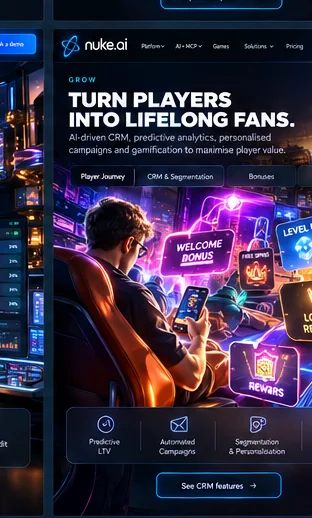
*Game availability, integrations and delivery depend on your market, provider approvals and agreed scope. See platform details
Illustrative workflow · sample data
LTV Hub example
No live operation is connected. The scenarios are fictional examples, not product results.
- 01Input
Sample question: which synthetic segment should a commercial owner review?
- 02Permission boundary
This example uses fictional segments only. Real campaigns require consent, promotional eligibility and responsible-gambling exclusions to be checked.
- 03Insight
Illustrative lifecycle cue for discussion, not a retention prediction. Example: an item remains within a fictional review threshold and is available for routine review.
- 04Human review
A commercial owner checks consent, self-exclusion and responsible-gambling restrictions before approving any contact. No player is contacted here.
- 05Audit trail
Illustrative review note: eligible audience, responsible owner and approval; this page saves no record.
Scenario changes are local to this browser. No customer, player, operational or personal data is processed.
Context before segmentation
Define the measure before trying to improve it.
Revenue, activity and lifecycle measures need consistent definitions, periods and exclusions. A segment is an operational decision, not a licence to contact someone.
- Use the minimum relevant data
- Separate observed outcomes from forecasts
- Check source quality and incomplete events
Eligibility and protection
Keep protection separate from promotion.
Consent, exclusions, market requirements and player-protection restrictions belong before a communication workflow, not after it.
- Eligible-audience checks
- Suppression across brands
- Appropriate human review
Evaluate carefully
A model score is not proof of an outcome.
Any experiment needs an owner, defined boundaries, a measurement method and a review of both commercial and protection outcomes.
- Document the hypothesis
- Set stopping conditions
- Review complaints and operational failures
Next step
Make the demo your own.
Use the minimum relevant data · Separate observed outcomes from forecasts · Check source quality and incomplete events. Bring the parts of your setup that matter to this discussion.
Share the context.
Use the minimum relevant data
Review the workflow.
Eligible-audience checks
Agree what comes next.
Document the hypothesis
Questions buyers ask
Questions, answered.
A few details worth knowing before we talk.
What should we check before contacting a player segment?
Review consent, exclusions, market requirements and player-protection restrictions, then confirm the approval process.
Can signs of harm be used to target promotions?
No. Signs of distress or escalating harm should trigger a protection review, not a promotional offer.
Are predictions or automated campaigns available for our setup?
Ask the product team to demonstrate the specific capability, data inputs, permissions and human controls for your scope.